
Everyone has an opinion. We often use them to rate things according to our experience or personal preferences. We rate a variety of things, such as: books, apps, communication style, services, worker appearance and professionalism, product quality, food quality, Uber/Lyft drivers, and much more.
Businesses often seek our opinions on their services through emails or apps from platforms like Google, Uber, Lyft, and other digital marketplaces. The ratings a customer provides are important to businesses because they’re a low-cost way to attract new customers. Even if the customer experience isn’t positive, providing honest feedback helps businesses improve their services for future customers.
Most companies make it easy to rate the products and services we use. When I finish an audiobook, a popup appears requesting feedback on the book as a whole, the story, and the narrator’s performance. Rating an Uber driver is pretty much a requirement since it’s nearly impossible to call your next ride without rating the previous one.
Uber even allows the drivers to rate you on how good of a passenger you are[1].
Ratings Defined
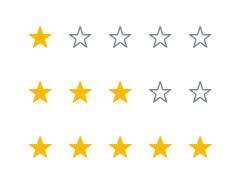
The most common rating system we’re familiar with uses 1-5 stars. We score the service or product based on how much we enjoyed it, but have you ever stopped to think what these ratings actually mean?
I agree with Google’s definition of star-based ratings. According to Google Maps, the number of stars awarded means the following:
- Hated it
- Disliked it
- It’s okay
- Liked it
- Loved it
5-Stars are Given Out Like Candy
As “The Thumbs Critic” on Google Maps, I refuse to cheapen my reviews with binary feedback. I rarely award 5-star ratings, reserving them for truly exceptional service. Unfortunately, some people tend to be binary when they rate products or services.
Many people simply leave a 1-star rating if the experience was bad. The same people may give a 5-star rating if the service was good, or if there weren’t any problems with a transaction. The problem is that most businesses want a perfect score. They mistakenly equate 4-star reviews as black marks. Technically, a 4-star rating (“Liked it”) is considered positive, while a 3-star rating (“It’s okay”) is neutral rather than negative.
The service may have been good, but it wasn’t truly exceptional.
Business owners or managers oftentimes respond to reviews with less than 5-stars, asking why they didn’t get a perfect rating. They’re so worried about receiving a 5-star rating, they overlook how a 4-star rating is still positive. Instead, they should read the comments about the service and product quality to understand what went well and what can be improved.
***
Think about how often you search for “restaurants near me” on Google. Did you choose one based on customer ratings? Similarly, consider how frequently you filter product results by customer reviews when shopping online.
Each of us has opinions about products or services, and providing honest feedback is important. Ratings and reviews are important to businesses because they can influence potential customers to visit or make a purchase. Don’t diminish your reviews with binary 1 or 5-star ratings, and don’t feel pressured into giving a 5-star rating if the service wasn’t exceptional.
Extra Content: Comparing 5-Star Ratings & Facebook Emoji Reactions 🤔
This is a hard question to answer. If you go by the 7 emoji reactions that are currently available on Facebook, there’s going to be a few “neutral” reactions that don’t exactly apply. I consider these to be neutral reactions, which don’t precisely signify approval of a post, comment, or pic: 😲 and 🤗 (Care).
Generally, I’d translate the Facebook reactions into 1-5 star reviews like this:
| Stars | Facebook Reaction |
| ⭐ | 😡 |
| ⭐⭐ | 😢 / 😲 |
| ⭐⭐⭐ | 👍 / 😲 |
| ⭐⭐⭐⭐ | 🤣 |
| ⭐⭐⭐⭐⭐ | ❤️ |
Similar to the 5-star system, “1” is the poorest or least liked and “5” the best or most liked.
1 = 😡
This means you hated what was posted or the post made you angry. This reaction is usually followed up with a scathing comment.
2 = 😢
While you don’t hate it, you still don’t like or approve of the message. The content may not make you angry, but could evoke negative emotions like sadness.
2 or 3 = 😲
This is an emoji I’d consider neutral or slightly negative. I tend to think of it in a couple ways.
“That’s crazy. I don’t know how to respond to that, so I’ll leave a shocked reaction.”
-OR-
“I’m shocked you posted or believe that. I’m against it, but familial obligations, or your sexiness[2], prevents me from commenting.”
3 = 👍
This is okay. I don’t disapprove of it, but I don’t want to spend the time or energy to hold my finger onto the reaction button to make another, more positive, reaction (much less, comment).
4 = 🤣
That’s funny as hell! I more than simply like it.
5 = ❤️
I love this! What I just saw/read resonates with me and my values.
🤗 Care?
For the purposes of this article, I consider the “care” reaction to be mostly neutral. However, I sometimes use it as a negative reaction when I encounter someone who overreacts or gets triggered by a post or comment. In situations like this, I think of it as being similar to the condescending phrase “bless your heart.”
[1] Uber Rider Ratings: I don’t like how Uber allows drivers to rate riders, because it’s a hidden form of intimidation towards the customer/rider. Many riders don’t provide honest feedback because they’re worried the driver will retaliate and provide a bad rider score.
I can hear the driver in the back of my mind saying, “Give me a 5-star rating, or else.”
[2] Sexiness: Sexy people get away with a hell of a lot of stuff online, just so long as they aren’t famous or public figures. A sexy person can say the vilest thing about any marginalized group, and hardly anyone will confront that person. That’s because most people are shallow and won’t risk alienating a potential mate.
Do you remember the national backlash at the 2021 verdict and sentencing of Rogel Lazaro Aguilera Mederos? Mederos was a truck driver who killed four people on an interstate due equipment failure and his unsafe driving. People took to social media to defend him. Most of the online warriors demanded for the charges to be dropped. The #1 reason for all the attention to this case was because he was sexy AF. The incident wouldn’t have garnered such attention if he was average-looking or… ugly. I called people out on how they were defending someone who killed four people, solely because he’s sexy, and an online lynch mob came out of nowhere to attack me (probably because I’m not a sexy twink anymore).
 Edwords wOrcs